
Lifesaving initiative: Medisol donates AED to gym
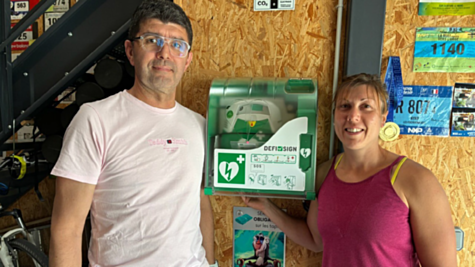
When Stéphane Mesnel suffered a sudden cardiac arrest at his local gym in Bellême, France, the people around him immediately took action. Their rapid response helped save his life. However, the incident also exposed an important gap: the gym did not have its own AED (defibrillator).
After recovering, Stéphane wanted to thank the gym and help protect everyone who exercises there. He therefore contacted Medisol with a special request. His goal was to arrange an AED for the place where his heart had stopped beating. Moved by his story, Medisol decided to donate the device.
A cardiac arrest without warning
On 21 April 2026, Stéphane was preparing to take part in his usual strength-training class. An active, non-smoking sportsman, he had no reason to expect that anything was wrong. Before the class had even started, he suddenly collapsed.
The people around him quickly realised that the situation was serious. They called the emergency services and started CPR. According to Stéphane, chest compressions began within approximately 40 seconds of his cardiac arrest.
Several people took turns performing CPR. Citizen responders, alerted through an emergency notification app, also came to help. Firefighters and other emergency services subsequently arrived at the scene.
An AED was collected from another nearby gym. Stéphane’s heart reportedly started beating again after the fourth shock. He estimates that he was in cardiac arrest for between 15 and 17 minutes. Continuous chest compressions helped maintain blood flow to his brain during this critical period.
A medical helicopter transported him to the university hospital in Caen. There, doctors discovered that he had a heart condition requiring surgery. Stéphane later stressed that the cardiac arrest was not caused by exercise and could have happened anywhere.
Saved by a chain of determined responders
Stéphane credits his survival to the people who refused to give up. Gym owner Fanny, fellow gym members, citizen responders and emergency professionals all formed part of the chain of survival.
Their actions demonstrate why recognising a cardiac arrest, calling the emergency services, starting CPR and using an AED as quickly as possible are so important.
The incident also highlights the value of first-aid training. Some of the people present had previously learned CPR and were able to act immediately. Rather than waiting for professional help to arrive, they started the lifesaving actions Stéphane needed.
His recovery has been positive. He has said that he experienced no lasting neurological effects from the cardiac arrest, something he attributes to the speed and persistence of the people who helped him.
No AED inside the gym
Although an AED was eventually brought to the scene, the gym itself did not have one. This meant valuable time was needed to locate and collect a device elsewhere.
After his recovery, Stéphane wanted to change that. As a thank-you to Fanny and the people at the gym, he began looking for a way to finance an AED for the facility. He contacted several organisations and companies to ask for support, including Medisol.
When the French Medisol team learned about Stéphane’s experience and his plan, the request was discussed internally. Medisol subsequently decided to donate an AED directly to the gym.
Medisol donates an AED to the gym
The donated AED has now been installed at the gym in Bellême. It will remain available if a visitor, employee or someone nearby suffers a cardiac arrest in the future.
For Stéphane, the donation is especially meaningful. The device has been placed at the location where he almost lost his life and where a group of people worked together to save him.
Fanny described the donation as a wonderful gift. In addition to installing the AED, she plans to register it in France’s national Géo’DAE database. This database records the locations of AEDs so that they can be found more easily when an emergency occurs.
First-aid training is also being arranged at the gym. This will help people learn how to recognise an emergency, perform CPR and use the new AED confidently.
Every minute matters during a cardiac arrest
A sudden cardiac arrest can happen to anyone, including people who are active and appear healthy. It can occur at work, at home, during exercise or in a public place.
An AED analyses the person’s heart rhythm and only advises or delivers a shock when a shockable rhythm is detected. The device provides clear instructions, allowing bystanders to use it while CPR is being performed and the emergency services are on their way.
Stéphane’s story shows that an AED is most valuable when it is close at hand, easy to find and ready for use. It also shows that a device alone is not enough. Calling the emergency services, immediately starting CPR and continuing until professional help arrives remain essential parts of the response.
Turning gratitude into greater safety
What began as a frightening incident has led to a positive initiative for the entire local community. Stéphane’s determination to thank the people who helped him has resulted in an AED being installed at the gym. The people who train and work there are now better prepared should another emergency occur.
For Medisol, donating the AED was a natural extension of its mission to make lifesaving equipment more accessible. Most importantly, Stéphane’s experience is a reminder of what can be achieved when ordinary people recognise an emergency, act quickly and refuse to give up.